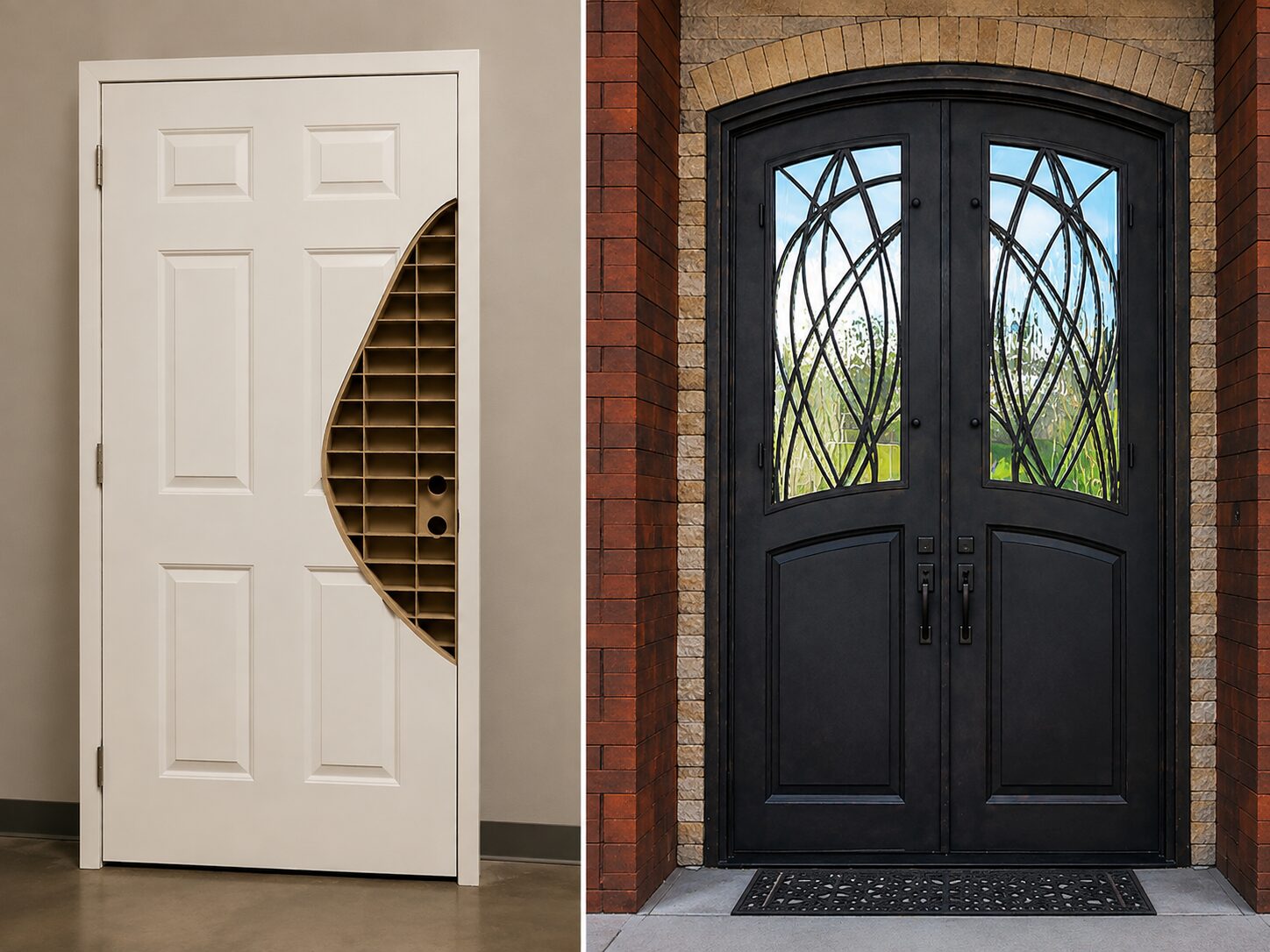
Custom Iron Doors vs Stock: The Difference Is Not Just the Price Tag Your Iron Door Is Letting the Cold In: Introducing …
- 402-932-9571
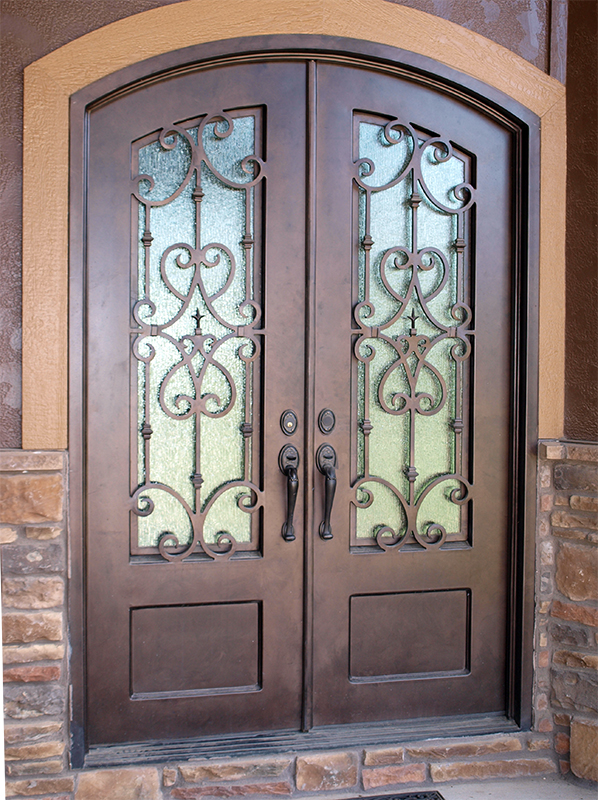
You have seen the price range on iron doors. The gap is real and it is significant. What is not always clear is what that gap actually represents.
Both a stock iron door and a fully custom iron front door are called iron doors. Both are made of metal. Both appear similar in a thumbnail photo. But they are not the same product, and understanding what separates them is the only way to make a confident decision about which one belongs on your home.
This is an honest breakdown of what each product actually is, where the price difference lives, and how to know which category fits your situation. We will tell you when a stock door is the right call. We will also tell you when it is not.
People Also Ask: What is the difference between custom and stock iron doors?
A stock iron door is a catalog product. The designs are predetermined, the dimensions are fixed to standard sizes, and the door is manufactured in volume, warehoused, and shipped when ordered. A custom iron door does not exist until it is ordered it is built from raw steel to a specific design, a specific dimension, and a specific home. The price, the timeline, the process, and the end result are different categories of product, not different tiers of the same one.
Stock iron doors are manufactured to fit the widest possible range of standard openings. The most common sizes are 36 by 80 inches for single doors and 72 by 80 inches for standard double configurations. The catalog typically offers anywhere from a handful to several dozen design patterns. You choose one. The door is pulled from inventory and shipped.
That process is not a flaw. For a homeowner with a standard door opening, a design preference that fits one of the available patterns, and a timeline that matters, a stock iron door can be a sound choice. The better manufacturers in this space make well-built products and they move fast. Two to four weeks from order to delivery is common.
The limitation is what you would expect from any off-the-shelf product. You pick from what exists. If your front door opening is a non-standard height, an arched frame, or a dimension that falls outside the catalog range, a stock door does not fit without significant modification. If your home has a specific architectural character that calls for a specific ironwork pattern, you work with what the catalog offers and accept the compromises that come with it.
Stock is a product category, not a quality category. The best stock door and the worst custom door can both fail to serve a buyer correctly. The question is which product was designed for your situation.
A custom iron door does not exist until you order it. There is no catalog. There is no warehouse inventory. There is no standard anything.
The design is built to your specification: your dimensions, your ironwork pattern, your glass configuration, your finish, your hardware. If your entryway is 84 inches tall with a sidelite on each side and an arched transom above, the door is built to that exact opening. If your home has a specific architectural detail you want the ironwork to reference, that conversation happens before a single piece of steel is ordered.
Custom means the iron front door that goes on your home was designed for your home. Not adapted from a template. Not modified from a stock unit. Built from raw steel to your approved drawing.
That applies to design and to dimension equally. A home with an unusual opening does not get a compromised fit. A buyer with a precise design vision does not get a catalog approximation. The door is the idea, built exactly.
At Midwest Iron Doors, we also build custom iron windows to the same specification. If your renovation or new build includes the surrounding architectural elements alongside the entry, the windows and door can be designed together same ironwork language, same finish, same engineering standard so the exterior reads as a single designed statement rather than a collection of separate purchases.
This is the question most buyers are actually asking when they look at the price gap. The answer is not one thing. It is three.
Those three factors compound. A door that requires more labor, higher-grade materials, and opening-specific engineering costs more than one that does not. That is the price gap, explained without decoration.
People Also Ask: Why are custom iron doors so expensive?
Custom iron doors are priced higher than stock because they require individual fabrication, heavier materials, and opening-specific engineering that stock production does not. Each door is built to a unique design and dimension by hand. The ironwork is welded, not stamped. The frame is engineered for the specific opening it goes into. None of that scales the way catalog production does, and the price is a direct reflection of what it takes to build something that did not exist before you ordered it.
Before Midwest Iron Doors builds anything, you get a shop drawing.
A shop drawing is a technical document that shows exactly what your door will look like and how it will be built. Dimensions, ironwork pattern, glass placement, frame profile, hardware locations. Every detail is drawn and sent to you for review before a single piece of steel is ordered.
You review it. You approve it. If something is not right, it gets corrected before production starts. This step exists because a custom door is not something you can return if the design is not what you envisioned. The shop drawing is the point where you confirm that what gets built is exactly what you had in mind — on paper, with every specification visible, before any money goes into materials or fabrication time.
Stock doors do not have shop drawings because there is nothing to draw. You choose from existing designs and what is in the catalog is what arrives. That simplicity is part of what makes stock products faster. It is also the reason they cannot serve a buyer with a specific vision for a specific home.
People Also Ask: What is a shop drawing for a custom door?
A shop drawing is a technical pre-production document showing every detail of the door before fabrication begins: exact dimensions, ironwork pattern, glass configuration, frame profile, and hardware placement. At Midwest Iron Doors, no production begins until the customer has reviewed and approved the shop drawing. It is the step that ensures the finished door matches the design exactly, and the protection that makes a $10,000 purchase something you commit to with confidence rather than uncertainty.
Sixteen weeks from design approval to installation is the standard for a custom Midwest Iron Doors build. That timeline covers shop drawing production, customer approval, material procurement, fabrication, powder coating, glass setting, quality inspection, and nationwide shipping.
Sixteen weeks is not slow. It is what building something correctly from scratch actually takes. Quality has a patience that shortcuts do not. That lead time is the cost of a door that did not exist before you ordered it one that was built to your opening, your design, and your climate, not pulled from inventory and shipped.
Stock doors ship in two to four weeks. If your timeline is the overriding factor and your opening fits a standard size, a stock door solves that problem. Custom does not compete on speed. It competes on everything else.
People Also Ask: How long does it take to get a custom iron door?
A custom iron door from Midwest Iron Doors takes approximately 16 weeks from shop drawing approval to installation. That includes design review, material procurement, fabrication, powder coating, glass setting, quality inspection, and shipping. Stock iron doors typically ship in two to four weeks. The difference in lead time reflects the difference in how each product is built — one is pulled from inventory, the other is built from nothing.
On warranty: every custom door ships with a 5-year limited warranty. Repair kits are included with every order so minor surface issues can be addressed without waiting on a service call. We back the door because we built the door.
Ready to see what your home calls for?
A shop drawing consultation costs nothing and commits you to nothing. It gives you an exact picture of what a custom iron door would look like on your specific home, built to your exact opening, before you make any decision.
If your new door is part of a broader exterior or home renovation, Precision Enterprises handles full-scope home remodeling in the Omaha metro — the same standard of craftsmanship applied to everything around the door.
Stock iron doors make sense in specific situations and it is worth being direct about what those situations are.
A stock iron door is the right call when the door opening is a standard size, the design preference fits one of the available catalog patterns, the timeline is tight, and the budget is significantly closer to the lower end of the iron door market. If those conditions apply, a quality stock door from a reputable manufacturer is a sound decision. There is no reason to spend $10,000 on a custom door if your situation does not require it.
A custom iron door makes sense when the opening is non-standard, when the home has a specific architectural character the door needs to match, when the design vision is precise and no catalog product approximates it, or when the ironwork of the entry needs to extend to sidelites, transoms, or custom iron windows that all work together as a single designed element. In those cases, stock does not serve the home it works around it. The compromise is visible every time someone approaches the front of the house.
There is a fourth reason worth naming directly. Some buyers are not choosing custom because of practical necessity. They are choosing it because a stock door, even a well-made one, is a door that also exists in other homes. In other neighborhoods. On other facades. A custom door belongs to one address, one style, one architectural moment. That distinction matters to some buyers and it is a legitimate reason to choose custom independent of any technical argument.
People Also Ask: Are custom iron doors worth the money?
For the right buyer, yes. A custom iron door is the correct product when the opening is non-standard, the design vision is specific, the home’s architecture requires a door that was made for it rather than adapted to it, or when the buyer wants a door that belongs exclusively to their home. For a buyer whose situation fits a stock door standard opening, catalog design, tight timeline custom is not necessarily worth the premium. The value depends entirely on which product was actually designed for your home and your situation. If you are unsure which category you are in, that conversation is worth having before you decide.

Midwest Iron Doors does not compete in the stock door market. We build custom. Any design, any dimension, no catalog, no compromises. If you are still working out which category your situation falls into, talk to us. We will tell you honestly whether custom is the right call or whether a stock door serves your home better.
Every custom door we build starts with a shop drawing. From the approved drawing comes the build. From the build comes a door that did not exist before you ordered it and will not exist again after. If your entryway has a specific dimension, a specific design vision, or a specific architectural character that stock simply cannot match, that is exactly the conversation we are built for.
We build for cold climates and warm ones. We ship nationally and install across the Midwest, Great Plains, and Northeast. We back every door with a 5-year limited warranty because we build things we are prepared to stand behind. The shop drawing consultation is free and it commits you to nothing it gives you a clear picture of what your home actually calls for before you make any decision.
A house with iron, a house with presence.
Building or Renovating in a Warm-Climate State?
Custom Iron Doors vs Stock: The Difference Is Not Just the Price Tag Your Iron Door Is Letting the Cold In: Introducing …
A wrought iron wine cellar door is the first thing anyone sees. Here is what to specify, glass, seal, and why interior doors skip the thermal break, before you order.
Iron door vs steel door: what separates a stock steel entry from a custom iron door, and which one fits your home.