
Your Iron Door Is Letting the Cold In: Introducing Thermal Break Doors Your Iron Door Is Letting the Cold In: Introducing Thermal …
- 402-932-9571
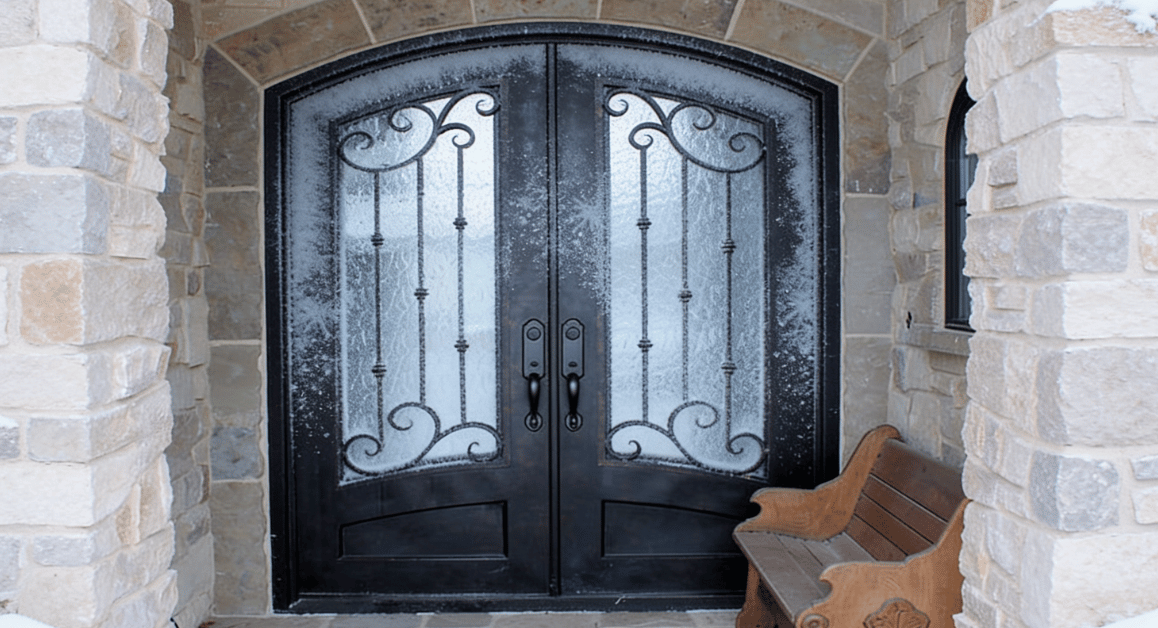
There is a problem with metal doors and cold weather that most companies in this industry would rather not talk about.
Metal conducts temperature. In warm climates, that is a minor inconvenience. In Nebraska, Iowa, Minnesota, Michigan, or anywhere temperatures drop hard in winter, it is a structural performance issue. An iron door or any metal-framed door without the right engineering transfers cold through the frame, causes condensation on the interior surface, and in hard winters can frost over completely on the inside.
We built Midwest Iron Doors specifically to solve that problem. We hold a US patent on 3rd-generation Thermal Break Technology the first of its kind in the iron door industry. Before we explain how it works, let us walk you through exactly why the problem exists, so you know what to ask for and what to avoid when shopping for a custom iron door in a cold-climate state.
This is physics, not a flaw specific to iron doors. Metal is one of the best thermal conductors that exist. When outside temperatures drop below freezing, the outer face of an unprotected metal frame gets cold fast. That cold does not stay on the outside of the frame. It travels through the metal to the interior face, because conductive materials do not hold temperature they transfer it.
The result is a door frame that is nearly as cold on the inside as it is outside. That creates two compounding problems.
First, heat loss. Your home is actively trying to stay warm. A cold-conducting frame pulls heat toward the exterior, which means your furnace works harder and your energy bills go up. This is why energy efficient front door performance matters not just the glass, but the frame itself.
Second, condensation. When warm interior air meets a cold frame surface, the moisture in that air condenses on contact. In moderate cold, that is a wet frame. In a hard Nebraska or Minnesota winter, that moisture freezes. You end up with frost on the inside of a door you paid significant money for and a frame that is now dealing with repeated freeze-thaw cycles it was not designed to handle.
There is also a mechanical side to this. Metal expands and contracts with temperature. Without proper engineering to manage that movement, frame seals shift, alignment drifts, and a door that opened perfectly in September starts fighting you in January. These are not cosmetic issues. They compound over seasons.
Without thermal break technology, yes. The metal frame conducts cold from outside to inside, and if seals are not engineered to handle thermal expansion, drafts develop over time. With a properly built thermal break iron door, cold transfer is interrupted at the frame, and seals stay intact through temperature swings. The difference in performance between a standard metal door and a properly thermally broken one is significant in any climate below 20 degrees Fahrenheit.
Condensation forms when warm, humid interior air contacts a cold surface. In a standard metal door, the interior side of the frame gets cold because metal conducts cold efficiently from the outside in. A thermal break interrupts that conduction path, keeping the interior frame surface warm enough that condensation cannot form. Without that barrier, moisture buildup is inevitable in cold climates and in hard winters, that moisture freezes.
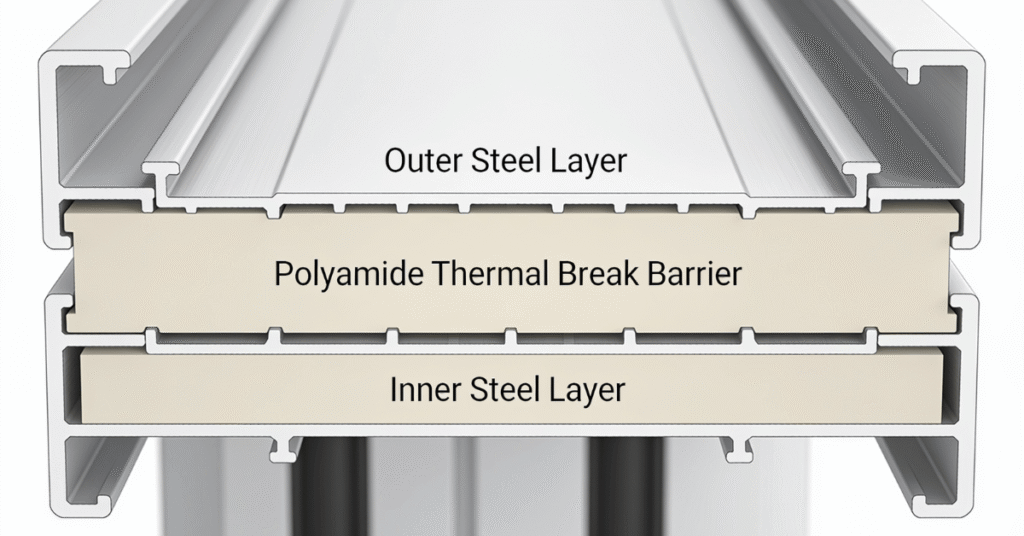
A thermal break is a barrier made from a low-conductivity material typically a structural polyamide placed between the outer and inner metal layers of the door frame. Its job is to interrupt the path cold travels through the metal.
Picture two conductors separated by a wall. The outer frame gets cold. The thermal break material does not transfer that cold efficiently to the inner frame. The interior surface stays significantly warmer than the exterior. Condensation cannot form. Frost cannot build. Heat stays inside your home.
The thermal break also manages the stress of thermal expansion. When the outer frame expands and contracts with temperature swings, that movement does not translate directly to the inner frame. The door stays aligned. The seals stay intact. A custom iron door built with our thermal break system opens the same way in January as it does in July.
Note: We are developing a branded name for this system — Arctic Core — to make the engineering advantage easier to reference.
A thermal break door is built with a non-conductive barrier typically polyamide between the outer and inner layers of the metal frame. This barrier stops the transfer of cold (or heat) through the frame, maintaining a warmer interior surface and eliminating the condensation and heat loss common in standard metal-framed doors. Not all thermal break doors are built to the same specification the generation of the technology and how the barrier is bonded into the frame both matter.
The thermal break material sits inside the frame assembly, between the outer steel exposed to weather and the inner steel facing your home. Because polyamide conducts heat and cold poorly, it acts as a wall the exterior can be below zero while the interior frame surface stays comfortable. The break also absorbs thermal expansion, keeping seals and alignment stable through season changes. The quality of that bond, and the material used, determines how well it holds up over years of hard winters.
Not all thermal break technology performs the same way. The concept has been around for decades in commercial window and curtain wall systems. What changed over time is how the barrier material is structured, bonded, and integrated into the frame.
First-generation thermal break systems used simple foam inserts. Functional at moderate temperatures, but compressible over time and prone to failure under the stress of real cold-climate conditions the kind of cold you get in the Midwest and Northeast, not the coastal variation of cold.
Second-generation systems improved the barrier material, but bonding methods were inconsistent. Performance varies significantly by manufacturer. Some hold up. Others do not, and there is no reliable way to know from the outside.
We hold a US patent on 3rd-generation Thermal Break Technology. The barrier material is a reinforced polyamide engineered to maintain its insulating properties across the full range of temperature extremes experienced in cold-climate states not just moderate cold, but the stretches of negative ten and below that define a Midwest or Northeast winter. It does not compress. It does not degrade. It is bonded into the frame as a permanent structural component, not inserted as an afterthought, and not removable over time.
That patent matters because it means no other iron door manufacturer in the United States is building to this specification. When you see a competitor offer thermal break as an option, ask them which generation their system is and whether it is patented. The answer tells you everything you need to know about how seriously they take cold-climate performance.
Third-generation thermal break technology uses a reinforced polyamide barrier that is structurally bonded into the frame not inserted or glued as a secondary step. It is engineered to hold its insulating properties through repeated freeze-thaw cycles and extreme cold, unlike earlier foam or thin-barrier systems that degrade over time. Midwest Iron Doors holds the US patent on this technology for iron doors, making it the only manufacturer in the country building to this specification.
The practical threshold is simple: if temperatures in your area regularly drop below 20 degrees Fahrenheit in winter, a thermal break door is not optional. It is the difference between a door that performs for decades and one that causes problems within two or three seasons.
That covers the entire Midwest and Great Plains Nebraska, Iowa, Minnesota, Wisconsin, Illinois, Indiana and most of the Northeast: Pennsylvania, New York, Connecticut, Massachusetts, and New England. If you are in one of these states and shopping for a custom iron door or any metal-framed door, thermal break should be the first question you ask, before design, before price, before lead time.
The Southeast and Southwest are a different story. In climates where temperatures stay above freezing most of the year, a non-thermal break iron door performs without issue. We build both. Our non-thermal break doors serve warm-climate homeowners with the same fully custom craftsmanship any design, any dimension, built to order. If you are in Florida, Texas, Arizona, or Southern California, we will build exactly what your home deserves without components you do not need.
Any state where temperatures regularly fall below 20 degrees Fahrenheit requires a thermal break iron door. That includes Nebraska, Iowa, Illinois, Indiana, Ohio, Michigan, Minnesota, Wisconsin, Pennsylvania, New York, and the New England states. If your winters include extended stretches of hard cold not just occasional frost, a standard metal door will develop condensation, alignment, and seal issues within a few seasons. Thermal break is not an upgrade in these climates. It is the baseline.
Yes, but only when built specifically for cold-climate performance. A custom iron door with patented 3rd-generation thermal break technology handles Midwest and Northeast winters without condensation, frost, or heat loss. A standard iron door without thermal break will fail in those conditions over time. The key question to ask any manufacturer is whether their thermal break is third-generation, structurally bonded, and independently verified — not offered as an optional upgrade.
If your iron door is part of a broader renovation or new build, Precision Enterprises handles full-scope home remodeling in the Omaha metro — the same standard of craftsmanship, applied to everything around the door.
We hear versions of this story more often than we should.
A homeowner in the Midwest orders a custom front door from a company that builds beautiful products for warm climates. The door arrives. It looks exactly as ordered the design, the finish, the glass. First season, it performs acceptably. The homeowner is pleased.
Second winter, the problems start.
Condensation appears on the interior frame during cold snaps. It is wiped down. It comes back. During a stretch below zero, the frame frosts over on the inside. The door starts feeling drafty near the frame. By the third or fourth season, the seal has shifted and the alignment has moved. A door that was effortless to open in September takes two hands in January.
What follows is frustrating because the homeowner paid significant money and the door is not defective in any traditional sense. The manufacturer built what they promised. The problem is that what they promised was not engineered for the climate it was installed in.
Remedies at this point are limited. The door can be re-sealed, but the underlying conductivity issue does not go away. The alignment can be adjusted, but it will drift again with the next round of temperature swings. The only real fix is a door that was built right for the climate from the start.
None of this happens with a properly built thermal break door. The interior frame stays warm. The seals stay intact. The door operates the same in the middle of a Nebraska January as it did on the day it was installed. The consistency is not a selling point it is the minimum standard for any iron door sold into a cold-climate market.
Not every company that mentions thermal break is building to the same standard. These are the five questions that separate a real cold-climate door from one that borrows the terminology.
Every door we build starts with a shop drawing you approve before production begins. Every door is built to exact specifications any design, any dimension, fully welded, no stock. And every door ships with a 5-year limited warranty backed by a company that has been engineering cold-climate iron doors since before most of our competitors understood the problem existed.
We ship nationally and install across the Midwest, Great Plains, and Northeast. If you are planning a new home build or a major renovation and want a door that matches the investment you have made in the rest of the property, talk to us before you decide.
The conversation is free. The shop drawing is free. What you get from it is an exact picture of what your home requires, built by the only manufacturer in the country with a patent on the technology that makes it work in a real winter.
A house with iron, a house with presence.
Your Iron Door Is Letting the Cold In: Introducing Thermal Break Doors Your Iron Door Is Letting the Cold In: Introducing Thermal …
Have you been looking for a way to make your home stand out from the rest of the houses on the block? …
You don’t have to look far to see that DIY projects have as much popularity right now as they ever have. Resources …
Our free shop drawing consultation gives you a detailed rendering of your custom iron door — dimensions, design, finish, and glass options — so you know exactly what you’re getting before a single dollar is spent.
Our free shop drawing consultation gives you a detailed rendering of your custom iron door — dimensions, design, finish, and glass options — so you know exactly what you’re getting before a single dollar is spent.

